My review of Greif, Mokyr and Tabellini’s book Two Paths to Prosperity: Culture and Institutions in China, 1000-2000 has appeared in the Times Literary Supplement. Pdf available here.
In the Dublin Review of Books, May 29th 2026:
The shadow of Edward Gibbon and Adam Smith hangs over two contemporary efforts to explain what makes nations wealthy and what makes empires decline.
The full article is here.
A long and very positive review here.
Most recent first:
La matinale de Radio Notre Dame, with Pierre-Hugues Dubois (in French), 15th April 2026:
https://www.rcf.fr/actualite/le-grand-invite-de-lamatinalercf?episode=677382&share=1
Entendez-vous l’éco, with Aliette Hovine in France Culture (in French), 23rd March 2026:
https://www.radiofrance.fr/franceculture/podcasts/entendez-vous-l-eco/le-marche-de-la-foi-6238684
Understanding human societies, with TSE students Manon Bonnet and Antsa Rharijaona:
Business Talk with Deepak Bhatt:
https://businesstalkwithdeepakbhatt.com
On reading all Jane Austen’s novels in quick succession:
At the beginning of January 2025 I decided to read all six of the main novels of Jane Austen, whose 250th birthday falls later this year (on December 16th). I began with Mansfield Park (MP), continued with Pride and Prejudice (PP), Emma (E), Sense and Sensibility (SS), Northanger Abbey (NA), and concluded with Persuasion (P). Although I had previously read all of them, some several times, I had never read them close together. Several things stood out for me as a result:
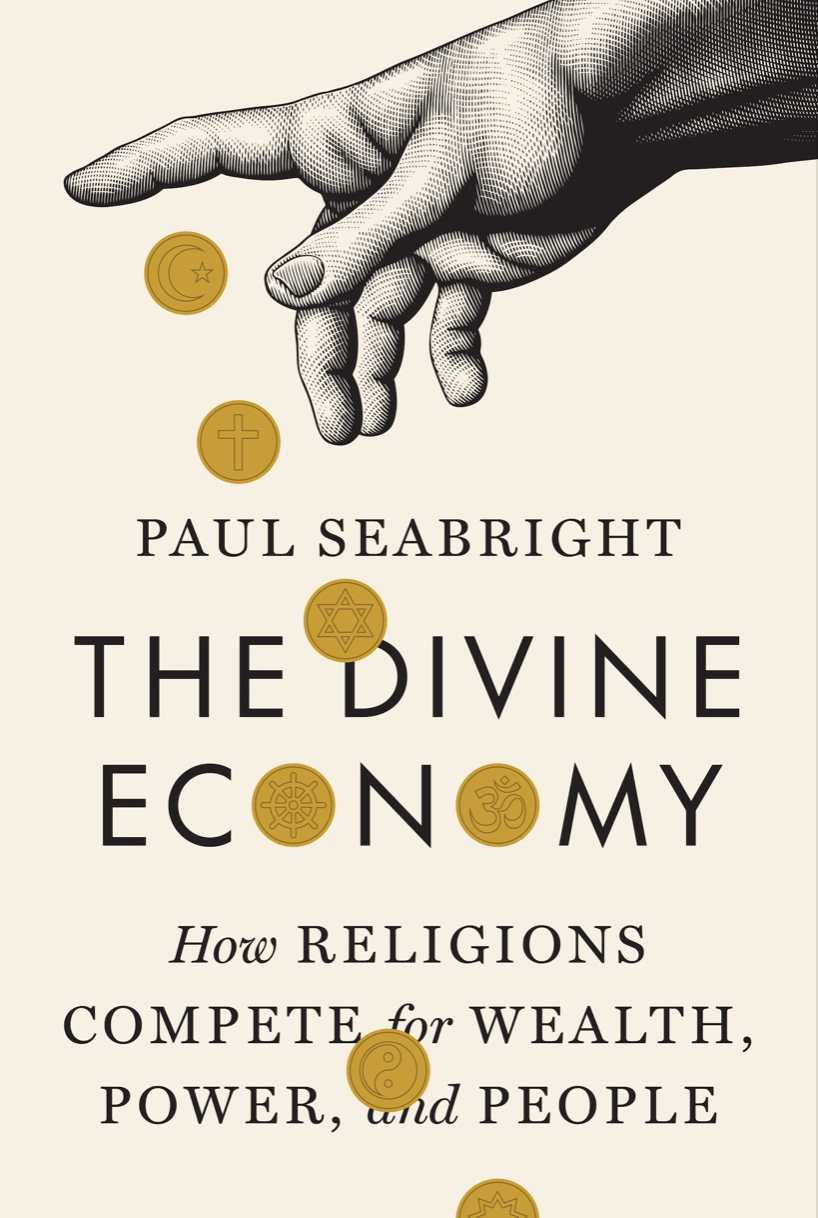
The French translation of The Divine Economy will be published on 29th January 2026 by Editions Markus Haller.
A really fun time with these two great interviewers on their podcast series Our Long Walk. You can listen here: https://www.youtube.com/watch?v=0_qSYAEneAQ
Sergey Gavrilets and I have a new paper published in the Proceedings of the National Academy of Sciences. You can find it here.
Abstract:
People and cultures differ in the extent to which they view the world as a zero-sum environment (where one person’s gain is another’s loss) or a positive-sum environment (where certain actions can benefit everyone). These beliefs shape individuals’ willingness to work, invest, collaborate, or show hostility toward out-groups, and accept or reject various social policies. We model dyadic interactions in a heterogeneous population where individuals biased toward a zero-sum worldview are more likely to invest in competition, while those biased toward a positive-sum worldview are more likely to invest in cooperation. The environment alternates stochastically between cooperative and competitive states. Without social influence, the more accurate worldview yields higher utilities and spreads throughout the population. However, assortative matching by bias can favor the positive-sum worldview even if a positive-sum environment is somewhat less likely. With peer conformity, inaccurate worldviews can persist after a structural change in the environment, leading to cultural evolutionary mismatch. In the presence of cultural authorities who can alter beliefs, either both worldviews can coexist or one excludes the other. Moreover, when assortative matching and conformity interact, authorities may profit by amplifying individuals’ biases, creating enclaves of similarly biased people who can pay the authorities enough to make investment in persuasive technology economically viable. Cultural evolutionary mismatch is more likely in cultures marked by strong peer conformity and high responsiveness to authority when the authority promotes a suboptimal worldview. This study demonstrates how real-world conditions, peer influence, and authority interventions can perpetuate or shift zero-sum and positive-sum worldviews-at times leading to inaccurate beliefs.
In a nod to the renewed sexiness of the subject of trade policy, the BBC re-broadcast in April-May 2025 my ten-part series from 2018, with a new final episode broadcast on 2nd May 2025. Details here. The episodes will be available for at least a year after they go out.