
• Home
  • Contact
  • About Me
Paul Seabright

.com

  • Home
  • About Me
  • Books
  • Research
    • New Research
    • Working Papers
    • Published Journal Articles
    • Published Book Chapters
    • Current Research
    • Ideas for Future Research
    • Collaborators and Co-authors
    • Conferences
  • Other Writing
  • Lectures, Podcasts, Teaching
  • Coups de Coeur
    • Visual Artists
    • Places
    • Recommended Books
    • Blogs and links
    • Curiosities
  • Français

Press and Reviews for The War of the Sexes

Picture credit: Boardroom battles….. The Apprentice. Photograph: BBC/PA Photo, from the review in The Guardian.

December 2013 update: Martin Wolf has chosen The War of the Sexes as one of his books of the year in the Financial Times:

“With characteristic brilliance, Seabright uses biology, sociology, anthropology and economics to explain the war of the sexes. Men and women must co-operate to bring their offspring to maturity and conflict is inherent. Yet today opportunities for more successful and equal relations between the sexes are greater than ever before.”

Other reviews:

In chronological order of appearance:

John Whitfield in Nature.

A favorable but somewhat surrealistically inaccurate review by Roger Lewis in the Daily Mail.

Jonathan Rée in The Guardian

Fran Hawthorne in The New York Journal of Books

Camilla Power in Times Higher Education

Alexander Delaigue in Liberation (in French)

Publishers’ Weekly

Anna Cristina Pertierra in Inside Story

Joshi Herrmann in The London Evening Standard

Michele Pridmore-Brown in the Times Literary Supplement, available here (pdf here)

Elaine Graham-Leigh in Counterfire


Some reactions in the blogosphere:

Jason Collins

Diane Coyle

Arnold Kling

Jake Seliger

Sander Van Der Linden in LSE Review of Books


My post at the Huffington Post blog


Interviews, other coverage:

The Financial Security Project at Boston College

The page 99 test

BBC Nightwaves, the interview runs from the 23 minutes point and lasts 11 minutes

VoxEU interview

The Moncrieff Show on Newstalk Radio Ireland, section 4, around 9 minutes in

Writers Read


Sexonomics

Sexonomics est le titre de la traduction française de The War of the Sexes: How Conflict and Cooperation Have Shaped Men and Women from Prehistory to the Present (Princeton UP 2012), qui a été publiée par Editions Alma le 4 octobre 2012.

Il y a eu une conférence de lancement le 16 octobre à Sciences Po Paris.

Des critiques dans la presse française on apparu ici:

Livres Hebdo, 29/09/2012

Le Monde Economie: Les LIvres de la Rentrée, 22/10/2012

Par rapport à l’édition anglais, Sexonomics a une bibliographie réduite, mais la bibliographie complète sera disponible ici.

Voici aussi quelques documents cités dans la bibliographie et difficilement disponibles ailleurs:

A.T. Kearney: Africa Mobile Observatory Full report 2011

A.T. Kearney Asia Pacific Mobile Observatory Full report 2011

Le titre Sexonomics a été utilisé par un livre anglais et un site web du même nom, tenu par le Dr. Adalbert Lallier, que vous pouvez trouver ici.

Ce titre est le sujet d’une marque déposée aux USA et au Canada. Même si le propriétaire ne détient pas de marque en France je reconnais volontiers la priorité de son utilisation du titre, et je vous recommande la visite de son site pour apprécier son approche originale et particulière.

What’s the Use of Economics? Teaching the Dismal Science After the Crisis

This book of essays edited by the excellent Diane Coyle was published on 15th September 2012; the Amazon page is here. Diane also has a column posted on Vox.

I have a very short note in it but many of the other entries are fuller and more rewarding to read.

Entretien sur l’aléa moral

Dans Le Nouvel Economiste du 13/09/12 (Emmanuelle Auriol est également citée):


Social Science Bites: A Podcast on the Relationship between the Sexes

I’m delighted to have been able to take part in the new Social Science Bites series of podcasts by the excellent Nigel Warburton and David Edmonds, the brains behind the very successful Philosophy Bites series.

Listen to the podcast here.

Five Books on Evolution and Human Cooperation

My interview and selection of Five Books is online at The Browser


President Lidia

A (loosely) political novel in which, through a series of accidents, a fashion model is elected president of an imaginary former Communist country


Download the pdf here

A Perfect Spy

A Perfect Spy, by John Le Carré. Published by Knopf in 1986, now available in a Penguin reprint.

I read this book when it first came out and thought it a masterpiece. I re-read it recently with some trepidation, fearing I would be embarrassed by my earlier enthusiasm. I needn’t have worried: it remains a brilliant novel by any standards, and the character of Rick Pym, the protagonist’s father, is unforgettable.

Buy here.

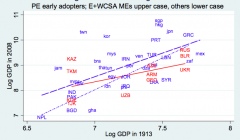
“Soviet Power Plus Electrification: what is the long-run legacy of communism?”

“Soviet Power Plus Electrification: what is the long-run legacy of communism?” (with Wendy Carlin and Mark Schaffer), available here, published in Explorations in Economic History 2012. http://dx.doi.org/10.1016/j.eeh.2012.07.003

Abstract

Two decades after the end of central planning, we investigate the extent to which the advantages bequeathed by planning in terms of high investment in physical infrastructure and human capital compensated for the costs in allocative inefficiency and weak incentives for innovation.  We assemble and analyse three separate types of evidence.  First, we find that countries that were initially relatively poor prior to planning benefited more, as measured by long-run GDP per capita levels, from infrastructure and human capital than they suffered from weak market incentives. For initially relatively rich countries the opposite is true. Second, using various measures of physical stocks of infrastructure and human capital we show that at the end of planning, formerly planned countries had substantially different endowments from their contemporaneous market economy counterparts. However, these differences were much more important for poor than for rich countries. Finally, we use firm-level data to measure the cost of a wide range of constraints on firm performance, and we show that after more than a decade of transition in 2002-05, poor ex-planned economies differ much more from their market counterparts, in respect to both good and bad aspects of the planning legacy, than do relatively rich ones.  However, the persistent beneficial legacy effects disappeared under the pressure of strong growth in the formerly planned economies in the run-up to the global financial crisis.

Transit of Venus

A transit of Venus took place in the early hours of Wednesday 6th June (CET)), beginning at 00.03.53 and ending at 06.55.24. There will not be another transit in our lifetimes.

The photograph above was taken in Minneapolis (hat tip Wikipedia)

More details, including viewing techniques and locations, are available at the Transit of Venus Project, one of the activities of the excellent organization Astronomers Without Borders.


← Older
Newer →
  • Tags

    BBC behavioural economics book book review cambridge university press central europe church company of strangers competition policy conformity Covid-19 darwin darwin college lecture Divine Economy economic history experiments feminism fiction Français gender Haiti History industrial organization Islam marriage markets networks non-fiction organizations podcast politics populism princeton Psychology radio regions of europe religion sexual selection supply chain teaching technology trade tribune Trust videos war of the sexes
  • Connect with us:
  • © 2026 Paul Seabright
  • Powered by WordPress