
• Home
  • Contact
  • About Me
Paul Seabright

.com

  • Home
  • About Me
  • Books
  • Research
    • New Research
    • Working Papers
    • Published Journal Articles
    • Published Book Chapters
    • Current Research
    • Ideas for Future Research
    • Collaborators and Co-authors
    • Conferences
  • Other Writing
  • Lectures, Podcasts, Teaching
  • Coups de Coeur
    • Visual Artists
    • Places
    • Recommended Books
    • Blogs and links
    • Curiosities
  • Français

New Research

Find below a list of the research I am currently completing or that has been recently published.

“Migration and the Equilibrium Prevalence of Infectious Diseases”, working paper with Alice Mesnard, available here.

“How Does Ranking Affect User Choice in Online Search?”, working paper with Mark Glick, Greg Richards and Margarita Sapozhnikov, available here.

“Cooperation Against Theft: A Test of Incentives for Water Management in Tunisia” (with Wided Mattoussi), forthcoming in American Journal of Agricultural Economics 2013. Available here.

Scott Morton, Fiona and Seabright, Paul, 2013 “Research into biomarkers: how does drug procurement affect the design of clinical trials?” Health Management, Policy and Innovation 1(3): 1-15. Available here.

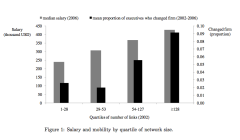
Professional Networks and their Coevolution with Executives’ Careers: Evidence from Europe and the US (with Nicoletta Berardi). Working paper, available here. Figure 1 above, drawn from that paper, shows how executives with larger networks are more likely to move between firms.

“Soviet Power Plus Electrification: what is the long-run legacy of communism?” (with Wendy Carlin and Mark Schaffer). Available here, published in Explorations in Economic History 2012. http://dx.doi.org/10.1016/j.eeh.2012.07.003

“The Three Musketeers: What Do We Still Need to Know About our Passage through Prehistory?”, Biological Theory, 2012, doi: 10.1007/s13752-012-0017-7 Available at SpringerLink OR [Download PDF of proof copy] [ Download PDF of related article by Sterelny ]

“The Birth of Hierarchy”, in Calcott et al (2013 forthcoming): Cooperation and its Evolution, MIT Press. PDF available here.
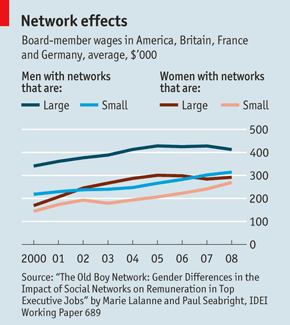
 

“The Old Boy Network: Gender Differences in the Impact of Social Networks on Remuneration in Top Executive Jobs”, IDEI Working Paper, no. 689, octobre 2011 (with Marie Lalanne), revised September 2012.




RSA Lecture – The War of the Sexes

This took place place on 15th May 2012 at the Royal Society of Arts, Piccadilly, at 6 pm. See the video here.

The White Tiger

The White Tiger, by Aravind Adiga. Published in October 2008 by The Free Press.

A funny, sparky, dark novel of corruption in modern India. Brilliantly describes how the rich manage to maintain a vast servant class in an equilibrium of subjection. The author has been a business journalist, and this greatly enhances both the range of his reference and his understanding for the way perverse incentives lead to collectively terrible outcomes. But although this gives him unusual insight into economic forces, the book is not didactic: he is a superb storyteller, and the book has a rich seam of unsettling malice.

Buy here

Memory: Fragments of a Modern History

Memory: Fragments of a Modern History, by Alison Winter. Published 2012 by Chicago University Press.

A superb account of the way in which attitudes to the reliability of memory developed during the 20th century under the influence of developments in academic psychology, legal pressures for reliable forensic diagnostic techniques, and most recently the “Memory Wars” of the 1980s and 1990s about the status of “recovered” memories of childhood sexual abuse. Concludes with an intriguing analogy between psychopharmacological methods for maniuplating memory, and the way in which the ability to feel pain, once considered more or less definitive of subjective psyhological identity, came to be considered much more contingent once the science of anesthesia made it possible to undergo painless surgical procedures.

Buy here.

On Lying, Risk-Taking and the Implosion of the Euro

The second PUP in Europe Annual Lecture lecture took place at Goodenough College on 18th April 2012.

The podcast is here: the slides are here.

Diane Coyle covered the lecture on her blog here, and the Guardian referred to it in an editorial.

I wrote this op-ed piece for the Guardian on the same theme on 21st May 2012.

Why Red Doesn’t Sound Like a Bell: Understanding the Feel of Consciousness

Why Red Doesn’t Sound Like a Bell: Understanding the Feel of Consciousness. By Kevin O’Regan. Published in June 2011 by Oxford University Press.

An account of the nature of consciousness based on recent discoveries in neuroscience, especially in the study of mechanisms of attention allocation. Makes a persuasive case that the subjective sensations generated by different sense modalities are grounded in the motor capacities we deploy for exploring the world. Contrary to a widespread illusion about sense perception, we do not experience the world as a simultaneous panorama; instead our brain fills in the many gaps in our sense perception because it can explore the external world to verify the hypotheses it makes when filling in. This is a very original and important contribution to the philosophical understanding of consciousness that undermines traditional claims about the incorrigibility of subjective experience; far from being incorrigible, subjective experience is frequently thoroughly deluded about its own nature. Buy here.

Sleights of Mind: What the Neuroscience of Magic Reveals About our Everyday Deceptions

Sleights of Mind: What the Neuroscience of Magic Reveals About our Everyday Deceptions. By Stephen L. Macknik, Susana Martinez Conde and Sandra Blakeslee. Published in November 2011 by Picador.

A tour by two leading neuroscientists and a fine science journalist of the many ways in which professional magicians exploit the known weaknesses in our mechanisms of allocating attention. Buy here.

Haiti: The Aftershocks of History

Haiti: The Aftershocks of History. By Laurent Dubois. Published in January 2012 by Metropolitan Books.

A remarkable history of Haiti since the revolution and independence. Excellently written, largely structured as narrative but with valuable discussions of many aspects of Haitian culture, economics and society; an eye-opener in its accounts of the many ways outsiders have used and imagined the country for their own purposes. A biography fully worthy of its subject, a troubled but remarkable country. Buy here.

Alma Editions

Les Editions Alma publieront en septembre 2012 une traduction par Mathieu Bathol de The War of the Sexes. Détails ici. Entre temps je vous recommande vivement leur offre de publications.

The War of the Sexes

Paul Seabright, The War of the Sexes: How Conflict and Cooperation have Shaped Men and Women Prehistory to the Present, Princeton University Press, published May 2012 (eBook April 2012)

As countless love songs, movies, and self-help books attest, men and women have long sought different things. The result? Seemingly inevitable conflict. Yet we belong to the most cooperative species on the planet. Isn’t there a way we can use this capacity to achieve greater harmony and equality between the sexes? In The War of the Sexes, Paul Seabright argues that there is–but first we must understand how the tension between conflict and cooperation developed in our remote evolutionary past, how it shaped the modern world, and how it still holds us back, both at home and at work.

Drawing on biology, sociology, anthropology, and economics, Seabright shows that conflict between the sexes is, paradoxically, the product of cooperation. The evolutionary niche–the long dependent childhood–carved out by our ancestors requires the highest level of cooperative talent. But it also gives couples more to fight about. Men and women became experts at influencing one another to achieve their cooperative ends, but also became trapped in strategies of manipulation and deception in pursuit of sex and partnership. In early societies, economic conditions moved the balance of power in favor of men, as they cornered scarce resources for use in the sexual bargain. Today, conditions have changed beyond recognition, yet inequalities between men and women persist, as the brains, talents, and preferences we inherited from our ancestors struggle to deal with the unpredictable forces unleashed by the modern information economy.

Men and women today have an unprecedented opportunity to achieve equal power and respect. But we need to understand the mixed inheritance of conflict and cooperation left to us by our primate ancestors if we are finally to escape their legacy.

Visit the book’s homepage at Princeton University Press.

Buy on Amazon.

See press and reviews

Endorsements:

“From the mating habits of praying mantises to the battlefield of corporate boardrooms, Paul Seabright takes us on a fantastic journey across time and disciplines to uncover why–and how–men and women have learned to work together, and what forces still keep them apart in modern society.”–Linda Babcock, coauthor of Women Don’t Ask: The High Cost of Avoiding Negotiation–and Positive Strategies for Change

“The War of the Sexes is a delight to read. Paul Seabright launches a charm offensive on those who would prefer not to think that gender differences have any biological basis, and an intellectual offensive on those who think that these differences are large and intractable.”–Terri Apter, author of Working Women Don’t Have Wives

“Come on a journey from the Pleistocene to the present–a fascinating trip that uses the economic causes and consequences of our reproductive choices to explain relations between men and women through the ages. I recommend this book to anyone interested in the battle of the sexes (which is certainly everyone I know!—-it’s a great read.”–Anne C. Case, Princeton University

Translation rights: Held by Princeton University Press. For all enquiries please contact kwilliams@pupress.co.uk

← Older
Newer →
  • Tags

    BBC behavioural economics book book review broadcasting markets cambridge university press central europe church company of strangers competition policy Covid-19 darwin darwin college lecture Divine Economy economic history economic life epidemics experiments feminism fiction Français gender Haiti History industrial organization marriage markets merger in daylight natural history networks organizations podcast princeton Psychology radio regions of europe religion sexual assault sexual selection supply chain teaching technology trade tribune videos war of the sexes
  • Connect with us:
  • © 2026 Paul Seabright
  • Powered by WordPress